Featured Intelligence
Your Watch Can Now Warn You About High Blood Pressure. What It Cannot Do Is Tell You That You Are Fine
Smartwatch hypertension notifications went live for millions of users this year, and the first serious independent evaluation of what they would actually catch was published in
Smartwatch hypertension notifications went live for millions of users this year, and the first serious independent evaluation of what they would actually catch was published in JAMA on February 9. Researchers at the University of Utah applied the notification criteria to nationally representative health survey data covering American adults without a known hypertension diagnosis. The finding is specific and important: roughly 59 percent of people with undiagnosed high blood pressure would never receive an alert.
That is not a failure of the feature. It is a description of what the feature is. The notification is designed to be highly specific, meaning it rarely fires without reason, and the price of that design is that it misses most of the cases it is looking for.
From the Lab to the Ledger
The watch is not measuring blood pressure. It has no cuff, and nothing on the wrist can currently produce a blood pressure number the way a cuff does. What the optical sensor tracks is how the vasculature responds over time, across many readings collected passively during normal wear. Sustained patterns consistent with chronically elevated pressure trigger a notification suggesting the user check with a real cuff. The design goal was a signal specific enough that people take it seriously, which is why it observes for an extended period before saying anything.
The Utah analysis made that trade-off concrete. Alerts would reach about 41 percent of adults with undiagnosed hypertension, while about 8 percent of people without hypertension would receive one anyway. The value of an alert also depends heavily on who receives it. In an adult under 30, a notification raised the probability of true hypertension from roughly 14 percent to 47 percent. In an adult over 60, where the underlying prevalence is far higher, it raised the probability from about 45 percent to 81 percent. The same alert carries a very different meaning at different ages.
The asymmetry runs the other way too, and this is the part the researchers emphasized. For someone over 60, receiving no alert still left a roughly one in three chance of having undiagnosed hypertension. A quiet watch is close to meaningless as reassurance in exactly the age group where the condition is most common and most consequential.
That matters because hypertension is the textbook silent condition. It produces no symptoms for years while it damages arteries, kidneys, the heart and the brain, and its treatment is among the best validated interventions in all of medicine. Anything that delays a diagnosis has a real cost. The researchers' concern was not false alarms but false reassurance, particularly among the groups least likely to be screened regularly.
Bio-Pipeline Ledger
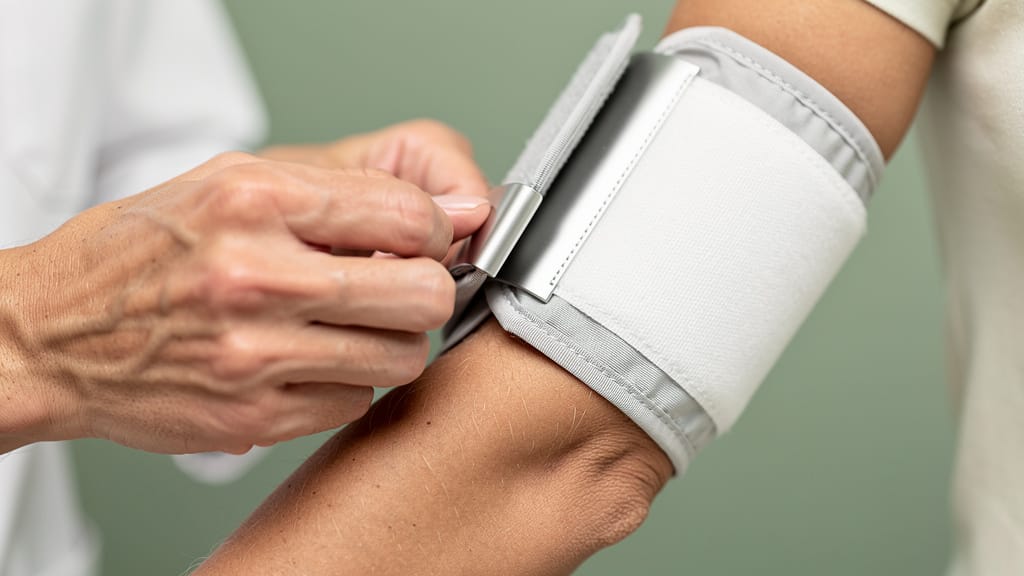
Validated cuff-based blood pressure measurement, in a clinic or at home: the established standard, inexpensive, accurate, and the basis of every treatment guideline. Nothing on the market replaces it.
Smartwatch hypertension notifications: FDA cleared as a screening aid for people without a diagnosis. Useful when they fire, uninformative when they do not, and explicitly not a measurement.
Cuffless wrist blood pressure readings that display an actual number: not validated to the standards used for medical devices. Accuracy varies widely and calibration drifts.
Home cuff monitoring for people already diagnosed: well established, and one of the more useful things a patient can do, since readings taken at home often reflect real-world pressure better than a single clinic measurement.
Ambulatory 24-hour monitoring ordered by a physician: the reference method for ambiguous cases, including pressure that is normal at home and high in clinic or the reverse.
Wearable-derived trend data as a supplement to any of the above: potentially useful, unstandardized, and not currently something treatment decisions are based on.
The Clinical Reality Check
What is established is that these notifications work as designed. When one appears, it meaningfully raises the odds that real hypertension is present, more so with age, and the correct response is to confirm it with a proper cuff and a clinician rather than to dismiss it.
What is overstated, mostly by inference rather than by the manufacturers, is the absence of an alert. Most undiagnosed hypertension in the population would not trigger one. Treating a silent watch as a clean bill of vascular health is the single most likely way this technology causes harm, and it is the specific point the study's authors made.
The practical version is short and cheap. A validated upper-arm cuff costs less than a month of most streaming bundles, and a blood pressure check is part of any routine visit. If the watch says something, act on it. If it says nothing, that is not information. The feature is worth having as an extra tripwire, and it earns its place only alongside the ordinary screening it was never built to replace.